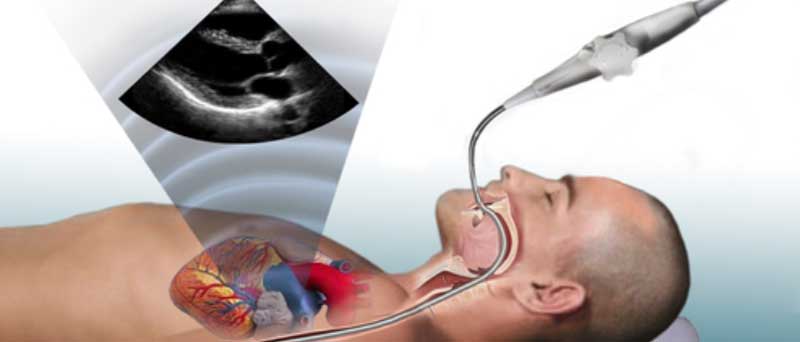
Transoesophageal Echocardiography (TEE): Detailed Heart Imaging from Inside
Transoesophageal Echocardiography (TEE) is an advanced ultrasound test that provides highly detailed images of the heart by placing a specialized probe inside the esophagus (food pipe).
Because the esophagus lies close to the heart, TEE offers clearer and more precise images than standard echocardiography, especially for complex heart conditions.
Why is TEE Performed?
TEE is recommended when more detailed heart imaging is required or when standard echocardiography is not sufficient.
Common uses include:
- Detecting blood clots in the heart
- Evaluating heart valve diseases
- Diagnosing infective endocarditis
- Assessing congenital heart defects
- Identifying cardiac tumors
- Monitoring heart during surgery
How Does TEE Work?
- A thin, flexible probe with an ultrasound transducer is inserted into the esophagus
- Sound waves create detailed images of the heart
- Since there is no interference from the chest wall or lungs, images are clearer
How is the Procedure Performed?
- The patient is asked to fast for several hours
- A local anesthetic spray is applied to numb the throat
- Mild sedation is given for comfort
- The probe is gently passed through the mouth into the esophagus
- Images are recorded in real-time
- The procedure usually takes 20–40 minutes
Benefits of TEE
- Provides high-resolution and detailed heart images
- More accurate than standard echocardiography in many cases
- Helps diagnose complex heart conditions
- Useful during cardiac surgeries and procedures
Risks and Safety
TEE is generally safe but may involve:
- Mild throat discomfort
- Gagging sensation during insertion
- Rare risk of injury to the esophagus
- Reaction to sedation (rare)
The procedure is performed under medical supervision to ensure safety.
Preparation for TEE
- Do not eat or drink for 4–6 hours before the test
- Inform your doctor about medications and allergies
- Remove dentures before the procedure
Recovery After TEE
- You will be monitored until sedation wears off
- Avoid eating or drinking until throat numbness resolves
- Mild sore throat may last for a few hours
When is TEE Recommended?
Doctors may suggest TEE if you have:
- Unexplained stroke
- Suspected heart infection
- Valve abnormalities
- Poor-quality standard echocardiogram
- Need for detailed cardiac evaluation
Our Specialist

Dr. Virender Singh Bhati
MD Physician, Clinical Cardiologist, PGDCC (SPS Apollo Hospital, Ludhiana)
Associate Consultant - Department of Cardiology, Fortis Hospital, Greater Noida